Village · Goriška Brda
Šmartno
A walled medieval hill village in the middle of the Brda vineyards, with five surviving corner towers.


Language
Language

Archaeological site
Photo: TadejM · CC BY-SA 4.0
Miren Castle is an elevation above the settlement of Miren near Nova Gorica, in southwest Slovenia. The origin of the name, which came into usage in the 16th century, remains unexplained.
Wikipedia · CC BY-SA 4.0
Visit for the Church of Our Lady of Sorrows, with Tone Kralj’s Pietà and religious paintings. The hill is also a pilgrimage site, with Stations of the Cross and a Scala Sancta chapel along the way.
Miren Castle is the name of a hill above Miren, not the site of a castle: historical research has found no castle there. The first recorded church on the hill was dedicated to Our Lady and is documented in 1488. Hermits lived here from the late 17th century, and devotion to Our Lady of Sorrows drew increasing numbers of pilgrims. A larger church was built in 1866, destroyed in the First World War, rebuilt between 1924 and 1931, then badly damaged again in the Second World War and restored later.
The present church is a three-aisled Neo-Romanesque basilica. Look for the Pietà by Tone Kralj above the main altar, his Stations of the Cross in the side-aisle lunettes, and the Rosary scenes high on the walls. The route up the hill has Stations of the Cross designed by Ivan Vurnik in 1931; near the last station is the Scala Sancta chapel, with 28 stepped platforms. St. George’s Parish Church is 1.3 km away.
Wikidata · Wikipedia (sl) · Wikipedia (en) · CC BY-SA 4.0
We have no accessibility data for this place. That does not mean it is inaccessible, please contact them directly.
Village · Goriška Brda
A walled medieval hill village in the middle of the Brda vineyards, with five surviving corner towers.
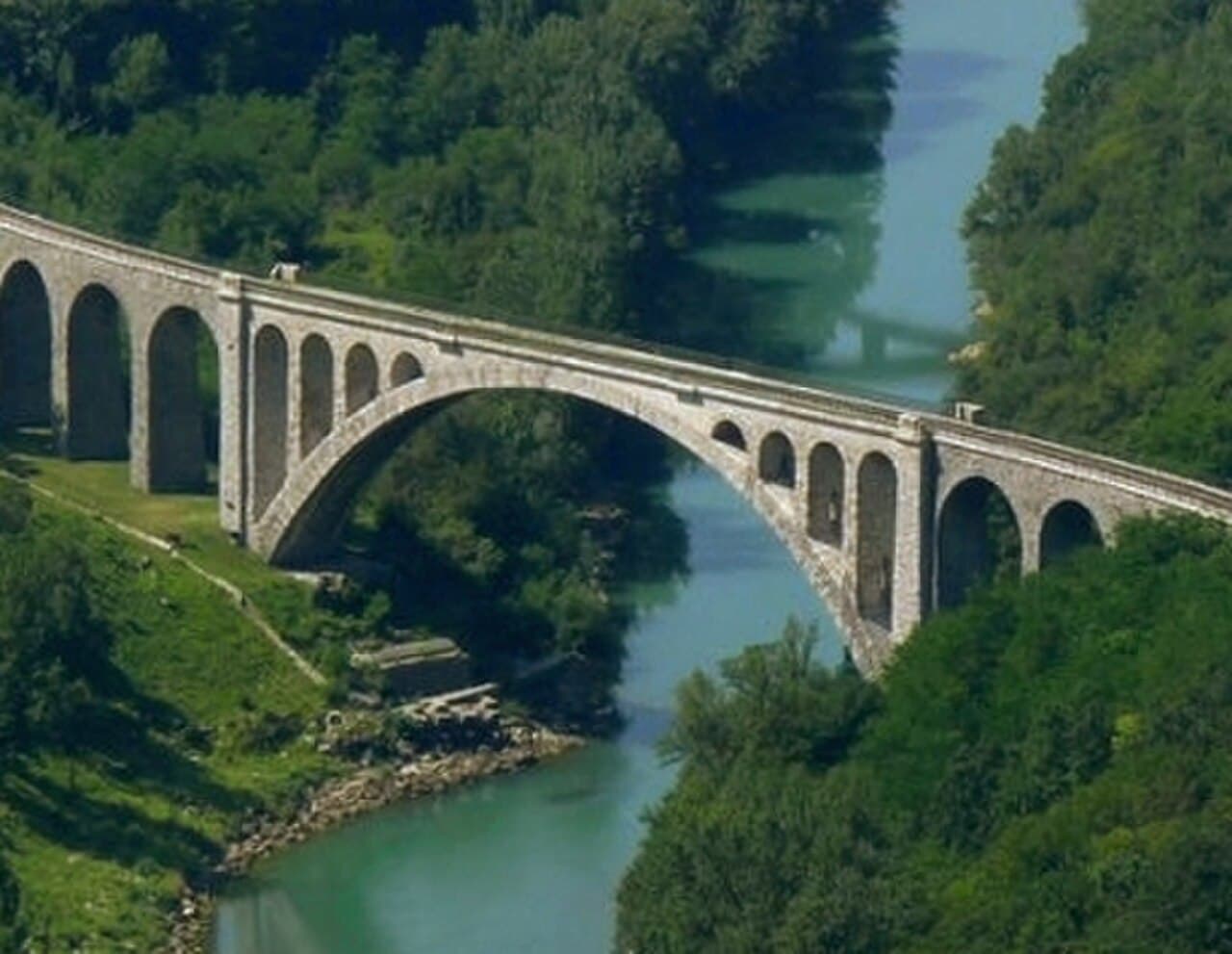
Architecture · Nova Gorica
7-meter (721 ft) arch bridge over the Soča River near Nova Gorica in western Slovenia. With an arch span of 85 meters (279 ft), it is the world's longest stone arch railroad bridge.· Wikipedia
Winery · Goriška Brda
A Brda estate whose vineyards straddle the Italian border, internationally known for minimal-intervention wine.
Winery · Vipava Valley
A Vipava valley family estate working without added inputs, and a reference point for Slovenian natural wine.
Restaurant · Vipava Valley
Tomaž Kavčič’s restaurant in a sixteenth-century hilltop manor above the Vipava valley.

Archaeological site · Vipava Valley
Castra ad Fluvium Frigidum, also simply Castra, referred to as mutatio Castra in Itinerarium Burdigalense, was a Late-Roman fortress (castrum) which constituted the centre of Claustra Alpium Iuliarum, an Ancient Roman defensive system of walls and towers stretching from the Gail Valley to the Učka mountain range.· Wikipedia

Archaeological site · Lipica
Vilenica Cave or Vilenica Cave at Lokev is the oldest show cave in Europe. The first tourists to the cave were recorded in 1633.· Wikipedia

Archaeological site · Idrija
Divje Babe is a karst cave and archaeological park overlooking the Idrijca River in northwestern Slovenia. It is noted for its Paleolithic remains, including the worked bone of cave bear known as the Divje Babe Flute, which has controversially been interpreted as a Neanderthal musical instrument.· Wikipedia

Archaeological site · Izola
Haliaetum was a Roman port that stood in the area of Simon Bay, next to the modern village of Jagodje, on the northern Adriatic coast of the Istrian peninsula. Remains visible at extreme low tide include parts of its pier as well as various port buildings.· Wikipedia