

Itineraries
Slovenia Itinerary: How to Spend 7 Days on Your First Visit
A tested seven-day route through Slovenia, from Ljubljana to the Julian Alps, the Soča valley, the Karst caves and the Adriatic coast, with real distances, where to base yourself and what to skip.
The LetsVisit team9 min čitanja
Ovaj je članak na engleski. Prijevod je na putu.

Slovenia is the rare country where a week is genuinely enough. It is about the size of Wales or New Jersey, and the drive from the highest road pass in the Julian Alps to the Adriatic takes an afternoon. That compactness is the whole argument for the route below: you can wake up under a 2,864-metre mountain on Thursday and eat grilled fish by the sea on Saturday without either day feeling like a transfer.
This is a first-visit itinerary. It takes the five things Slovenia does better than its neighbours: a walkable capital, an alpine lake, a river valley the colour of swimming-pool water, caves on a scale that is hard to believe, and a Venetian town on a peninsula. They go in the order that costs the least driving.
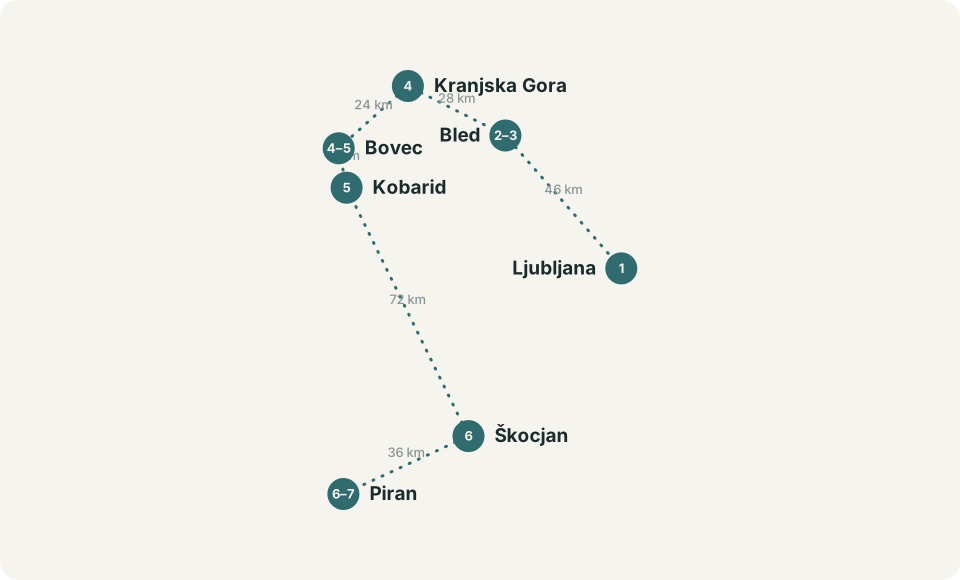
The route at a glance
Four bases in seven nights, and only one of them for a single night. Moving every day is the most common mistake on a first Slovenian trip: the drives are short, so it feels free, but packing and parking is still an hour a day you do not get back.
Day | Base | What it is for | Drive that day |
|---|---|---|---|
1 | The capital, on foot | None | |
2–3 | The lake, the gorge, Bohinj | About 45 min | |
4–5 | The Vršič Pass and the Soča | 2–3 h over the pass | |
6–7 | Caves, then the coast | About 2 h in total |
Day 1: Ljubljana, slowly
Start where you land. Ljubljana is a capital city with a population smaller than most European suburbs, and its centre is closed to cars, which means the first day of your trip can be spent entirely on foot with no decisions in it.
Walk the river. The Triple Bridge is the centre of everything: three bridges side by side, rebuilt in the 1930s by Jože Plečnik, the architect whose fingerprints are on half the city. From there the Ljubljanica is lined with cafés on both banks, and the Central Market sits just upstream.

Go up to Ljubljana Castle for the view over the red roofs to the Alps. There is a funicular if you would rather not walk up the hill. If you have an afternoon left over, Tivoli Park starts two streets from the centre and runs into woodland, and the National Gallery is small enough to see properly in an hour.
Pick up the motorway vignette today if your hire car does not already have one. It is electronic and tied to the plate, and you want it before you join the motorway, not after.
Day 2: Ljubljana to Lake Bled
Forty-five minutes on the motorway and you are at the lake. Go in the morning: Bled empties out in the late afternoon when the coach tours leave, but the light on the island is best early and the car parks fill by ten.

The island is the thing. A pletna (a flat-bottomed wooden boat rowed standing up, a right handed down through a short list of Bled families) takes you across, and there are 99 steps from the jetty to the church door. You can also row yourself across in a hired boat, which is cheaper, slower and more fun.
Then Bled Castle on its cliff for the postcard view down onto the island, and a piece of kremšnita (the custard-and-cream slice the town is known for) on a terrace afterwards.
If you only climb one hill here, make it Mala Osojnica. It is steep, it is about twenty minutes of steps and roots, and it is the view that sells Slovenia.
Day 3: Vintgar Gorge and Lake Bohinj
Two very different half-days, both within half an hour of your bed.
Vintgar Gorge is a boardwalk pinned to the rock wall above the Radovna river for about a kilometre and a half, built in 1893 and still following the same line. It is one-way and timed in high season, which keeps it from becoming a queue. Go first thing.

In the afternoon drive 20 km to Lake Bohinj, which is three times the size of Bled, surrounded by the national park rather than by hotels, and the place Slovenes go when Bled gets busy. Swim if it is warm. Take the Vogel cable car up for the view back over the lake to Triglav, or walk the hour to the Savica waterfall at the head of the valley.
Day 4: over the Vršič Pass to the Soča
The best driving day in the country, and the one most first-timers miss. From Bled it is about 40 minutes to Kranjska Gora, and from there the road climbs to the Vršič Pass at roughly 1,600 m in fifty numbered hairpin bends: twenty-four up the north side, twenty-six down the south.

Stop at the Russian Chapel on the way up, built by Russian prisoners of war in 1916 in memory of the men killed building this road, and stop again at the top, because that is the point of it.
Allow two to three hours for a drive that is 45 km on paper. The bends are cobbled in places, the camper vans are slow, and you will want to get out repeatedly.
Vršič is a seasonal road. It closes for the winter and the reopening date depends on snow clearing, so in October, and certainly outside the warm half of the year, check that it is open before you commit to this day. The long way round, through Predel or back via Ljubljana, works but costs most of a day.
Down the far side the road meets the Soča, which is the colour people assume has been edited. Base in Bovec.

Day 5: the Soča valley
Bovec is Slovenia’s outdoor-sports town: rafting, kayaking and canyoning on the river, zip lines above it, and the Boka waterfall visible from the road. If none of that appeals, the valley is just as good at a walking pace.
Drive 10 km down to Kobarid. This quiet town was the centre of the Isonzo Front, where more than a million men fought across these mountains between 1915 and 1917, and the museum in the middle of it is one of the best war museums in Europe. It is about the soldiers rather than the generals. The Kobarid Historical Walk loops out of town past the trenches, a WWI charnel house and the Kozjak waterfall, which falls into a round chamber of rock that looks built rather than eroded.

Kobarid is also, unexpectedly, one of the best places to eat in Slovenia. Book dinner before you arrive, not on the day.
Day 6: the Karst, caves and then the sea
Leave the mountains behind and drop onto the Karst, the limestone plateau that gave the word "karst" to geology and is hollow underneath.
You have two great caves and no real need to do both:
Postojna Cave: a 24 km system you enter on a small electric train, with vast decorated chambers and an aquarium of olms, the blind cave salamander that lives nowhere else in such numbers. Busy, slick, genuinely spectacular, and easy with children or with limited mobility.
Škocjan Caves: a UNESCO World Heritage site since 1986, and a different experience entirely: a walk on foot along a gorge the Reka river cut underground, across a bridge forty-five metres above the water. Fewer people, more steps, and the one that tends to stay with you.

Ten minutes from Postojna, Predjama Castle is built into the mouth of a cave in a cliff face: a real castle in a real cave, not a castle near one.

Then it is 45 minutes to the coast. Slovenia has 46 km of it, and the best of it is Piran: a Venetian town packed onto a peninsula, which you park outside and walk into.
Day 7: Piran, and the way home
Give the morning to the town itself. Tartini Square is an oval of marble where the inner harbour used to be, named after the violinist Giuseppe Tartini, who was born on it. Climb the bell tower or walk up to the town walls for the view along the coast to Croatia and, on a clear day, across the gulf to Italy.

Eat fish. Then drive back to Ljubljana in about an hour and a half, or straight to the airport in a little over two.
What we left out, and when to put it back
This route deliberately ignores the eastern half of the country, which is a different holiday: Ptuj, the oldest town in Slovenia, the thermal spas of Podčetrtek and Moravske Toplice, the vineyards of Jeruzalem above the Drava plain, and the old vine in Maribor. None of it fits in a week that already includes the Alps and the sea.
Two other common additions and what they cost you:
Logarska Dolina: a glacial valley closed off by a wall of mountains, about 38 km from Ljubljana as the crow flies but a long way round by road. Worth a full day, not a detour.
Velika Planina: a high pasture of herdsmen’s huts above Kamnik, reached by cable car. Half a day, and the easiest "mountain" day in the country.
Practical notes
Driving
Roads are good and signage is clear. Motorways need the electronic vignette; mountain roads do not. Fuel is normal-priced by European standards. Town centres in Ljubljana, Piran and Bled are closed or hostile to cars. Park on the edge and walk in, which is always signposted.
Where to stay
Bases beat hotels-per-night here. Two nights in Bled, two in Bovec and two in or near Piran leaves one night in Ljubljana at the start, and no day with more than two hours of driving in it.
Money and language
Slovenia uses the euro. English is widely spoken, German and Italian often near the respective borders. Cards work almost everywhere, including small mountain huts, but carry some cash for parking machines and smaller places.
What this costs in time, honestly
Everything above assumes you are prepared to start the day before nine. The route works perfectly well at a slower pace if you drop one of the two caves and the Bohinj afternoon.
Build this route around your own dates
The day of the week matters more in Slovenia than most people expect: museums shut on Mondays, mountain huts close in autumn, and the Vršič Pass closes with the snow. Tell our planner when you are coming and it will build the week around what is actually open on those days. And if you would rather have somebody else drive, the tours and tickets we list are the same ones the itinerary points at.
Pitanja koja ljudi postavljaju
Is 7 days enough for Slovenia?
Seven days is enough to see the Alps, the Soča valley, the Karst caves and the coast without rushing, because the country is small: the longest single drive on this route is about an hour and a half. It is not enough to add the east as well. If you want Maribor, Ptuj and the thermal spas, either give them a second trip or drop the coast.
Do I need a car for this Slovenia itinerary?
For this route, yes. Ljubljana, Bled, Postojna, Koper and Maribor are all reachable by train or bus, but the Vršič Pass, the upper Soča valley and most trailheads are not, and the connections that do exist eat the day. If you would rather not drive, base yourself in Ljubljana and Bled and use day tours for the rest.
What is the best month to visit Slovenia?
Late May to late June, and September. You get open mountain roads, long days and water warm enough to swim in, without the July and August crowds at Bled and on the coast. October is beautiful and quiet but the high passes can close with early snow.
Which airport should I fly into?
Ljubljana (LJU) is the obvious one and sits 25 km from the city. Many visitors fly into Venice, Trieste, Zagreb or Klagenfurt instead and drive in. Trieste is particularly close to the Karst and the coast, so it suits this route run in reverse.
Do I need a motorway vignette?
Yes, if you use the motorways, which this route does. Slovenia uses an electronic vignette tied to the number plate, bought online or at petrol stations before you drive onto the motorway. Hire cars from Slovenian branches usually have one; cars hired abroad usually do not.
- #slovenia
- #itinerary
- #road trip
- #first visit
- #julian alps